A College Dropout Wrapped Git in a Social Network at a San Francisco Sports Bar: How Chris Wanstrath Hooked 100M Developers with Little Green Squares and Sold GitHub for $7.5B
In the history of software engineering, few partnerships are as poetic as the unplanned symbiosis between Linus Torvalds and Chris Wanstrath.
In April 2005, frustrated by existing version control tools, Linux creator Linus Torvalds locked himself in his office and wrote Git in just ten days. It was a masterpiece of distributed systems engineering—blazingly fast, cryptographically tamper-proof, and built for the Linux kernel.
Yet for its first three years, almost no ordinary software developer wanted to use it. Early Git was a bare-knuckle command-line engine with over a hundred arcane plumbing commands. If you wanted to contribute a three-line bug fix to someone else’s open-source project, you had to format a .patch file locally and email it to a mailing list, praying a maintainer would notice and manually apply it.
If Linus Torvalds built a raw nuclear reactor with no steering wheel, seats, or dashboard, who wrapped it in a cockpit so intuitive that 100 million developers climbed inside?
Ranked #58 (OVR 85) on our World’s Greatest Product Managers board is Chris Wanstrath (@defunkt), the college dropout who sketched GitHub on a bar napkin in San Francisco and turned “Social Coding” into the default home of human software.
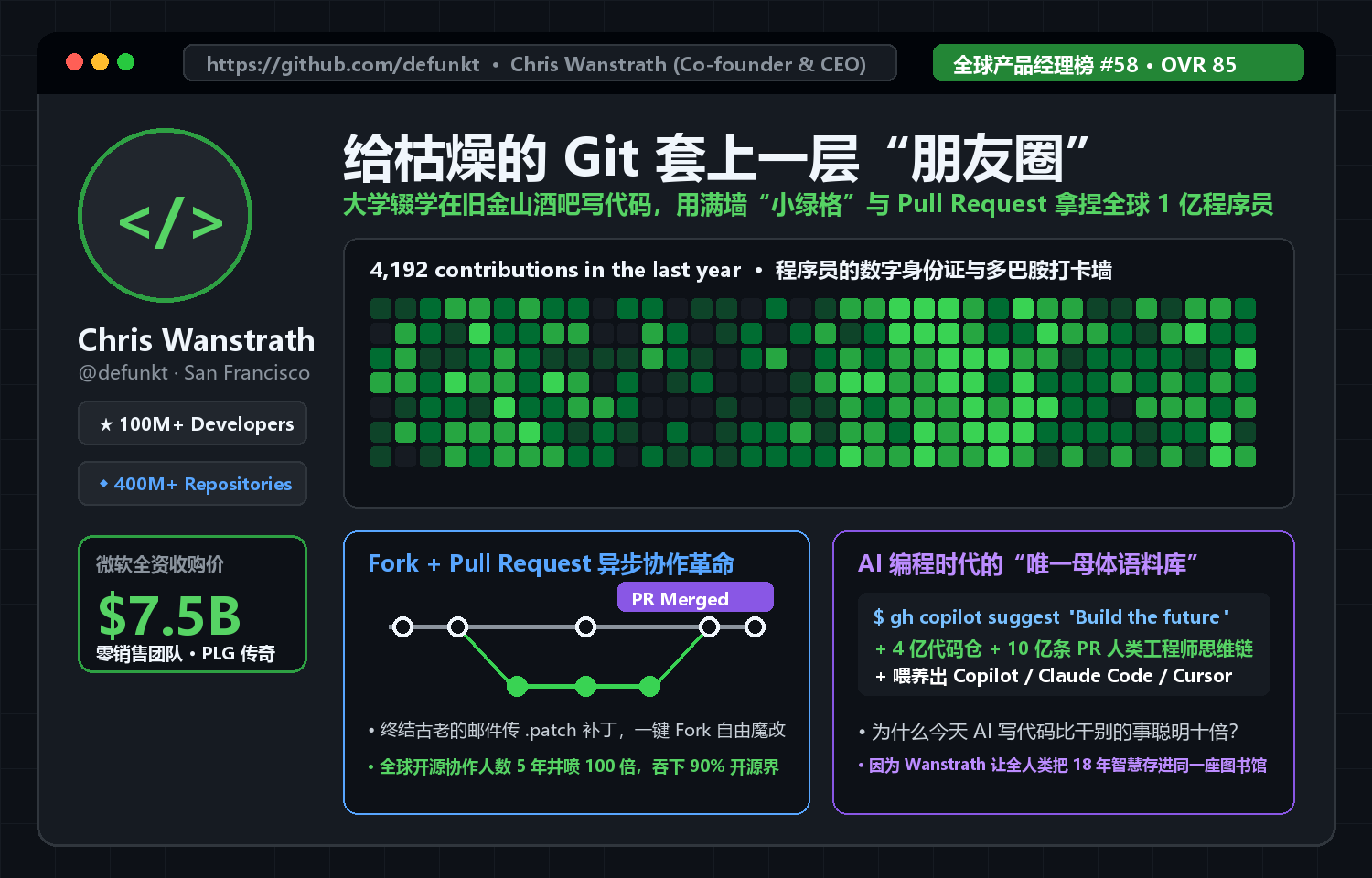
1. The Epiphany at 21st Amendment Bar: Why Shouldn’t Coding Feel Like a Social Network?
Born in 1985 in Ohio, Chris Wanstrath dropped out of the University of Cincinnati where he was studying English, bought a one-way ticket to San Francisco, and taught himself Ruby on Rails to land a web developer job at CNET.
In the autumn of 2007, 22-year-old Wanstrath met fellow developer Tom Preston-Werner for drinks at 21st Amendment, a noisy sports bar near South Park in San Francisco. Both loved the speed of Git, but hated the agony of setting up SSH servers and user permissions just to share a repository with a friend.
Over their second pint, Wanstrath articulated an insight that permanently altered how humanity builds software:
“Everyone was falling in love with Facebook, Twitter, and Flickr. You could follow a photographer, favorite their shots, and leave comments. Why was it that when programmers shared code, we were still stuck on 1970s mailing lists and graveyard directories like SourceForge? Coding isn’t a solitary chore—coding is fundamentally social! What if every developer had a profile page, and sharing code was as effortless as retweeting?”
Without raising a dollar of venture capital or writing a pitch deck, they coded on nights and weekends for three months and launched GitHub.com in April 2008.
2. Three Masterstrokes of Product Design That Hooked 100 Million Engineers

A. Fork + Pull Request: Eliminating 90% of the Social Friction in Open Source
Before GitHub, contributing to an open-source project required begging strangers for “commit access” to their central server. Wanstrath replaced gatekeeping with a frictionless two-button asynchronous loop:
- Fork: With one click, any developer could clone an entire public repository under their own username in one second—no permission required—and experiment freely.
- Pull Request (PR): When ready, clicking New Pull Request sent the original author a clean visual diff card showing red deleted lines and green added lines, complete with inline comment threads and emoji reactions, ready to merge with a single green button.
B. The 365-Day “Little Green Squares” (Contribution Graph): Gamifying Developer Identity
On every user’s profile page, GitHub placed a 52 × 7 pixel matrix representing every day of the past year. Every commit or pull request painted that day’s square a richer shade of emerald green. By tapping into the universal human psychology of streak preservation (years before Duolingo made it famous) and professional pride, those little green squares turned coding into a daily habit—and rapidly replaced the traditional paper résumé across the global tech industry.
C. The Textbook PLG Flywheel: Free for Public Open Source, Paid for Corporate Secrets
How did a bootstrapped startup survive hosting millions of repositories? Wanstrath devised one of the cleanest Product-Led Growth (PLG) pricing models ever conceived:
- 100% Free Forever if your repository is public and shared with humanity.
- Paid Subscription ($7/mo and up) the moment you flip a switch to make the repository Private.
Developers fell in love with GitHub on weekends while building open-source tools, then marched into their offices on Monday morning and demanded their CTOs buy GitHub Enterprise for work. GitHub grew to millions in profit before ever hiring a single salesperson.
3. From $7.5 Billion Microsoft Acquisition to the Mother Corpus of AI Coding
In June 2018, Microsoft—once the mortal enemy of open source—acquired GitHub for $7.5 billion. And in the AI era of 2026, Wanstrath’s creation has proven even more consequential: the reason frontier AI models (from GitHub Copilot to Claude Code) are superhuman at software engineering is that Chris Wanstrath spent eighteen years persuading 100 million programmers to store every line of code, every bug report, and every pull-request reasoning chain in one structured, open sanctuary.
Discussion