Thrown Out of the Company He Founded, He and His Brother Built a Billion-User Encrypted Messenger
What do you do when the multi-billion-dollar social network you coded and built from scratch at age 21 is seized from you in a hostile takeover, forcing you out of your own headquarters and into permanent exile?
Most founders either spend the rest of their lives in courtrooms or buy a superyacht and retire.
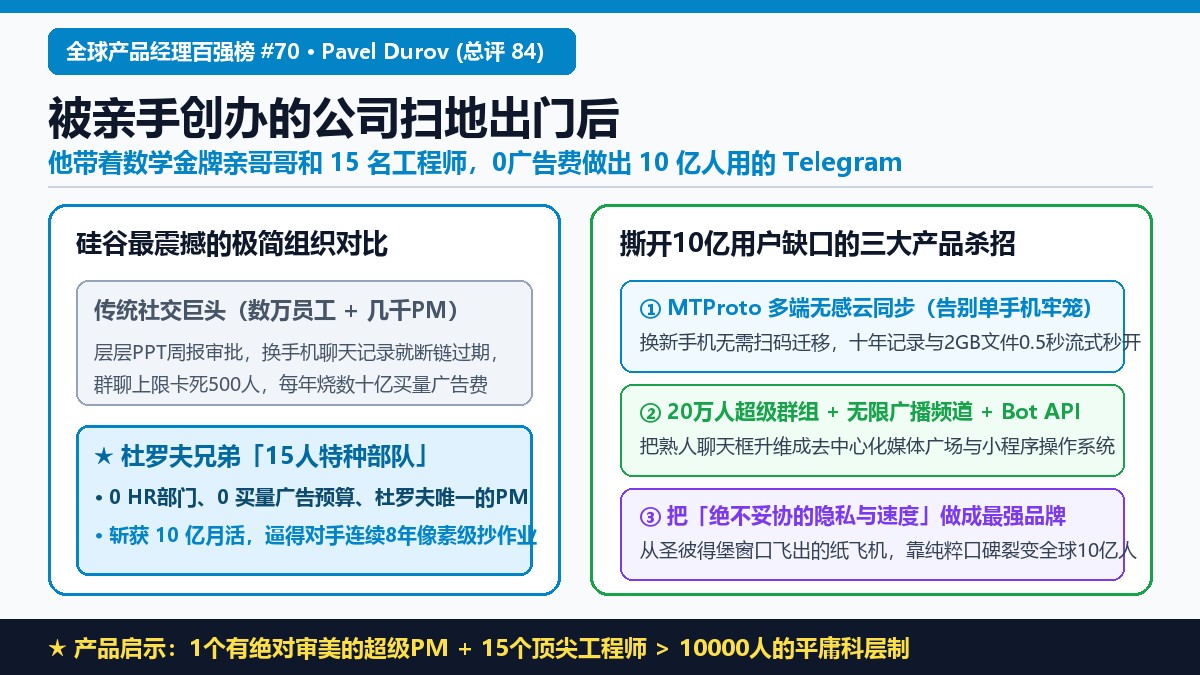
Pavel Durov chose a third option: he packed his bags, took his older brother Nikolai Durov (a two-time International Mathematical Olympiad gold medalist and two-time ACM ICPC world champion) along with a tiny band of loyal engineers, and built an even larger, faster, billion-user communications empire from hotel rooms across the globe—Telegram.
On the doaipm.com Top 100 Product Managers leaderboard, Pavel Durov ranks #70 (Overall 84, Scale scl: 88, Taste tst: 84): “Thrown out of the VK he founded, he made refusal-to-compromise itself the product’s sharpest selling point.”
1. The Knock on the Door That Sparked Telegram
In 2006, fresh out of Saint Petersburg State University, Pavel and Nikolai Durov launched VKontakte (VK). While Facebook struggled to gain traction in the Russian-speaking world, VK dominated with over 100 million users thanks to blazing speed, built-in media streaming, and obsession with clean UI.
The turning point came between 2011 and 2013 when authorities demanded that VK shut down opposition groups and hand over private user data. Durov refused publicly. Soon after, armed SWAT officers appeared outside his Saint Petersburg apartment.
Looking through the peephole, Durov reached for his phone to coordinate with his brother Nikolai—and froze:
“I realized that I didn’t have a single safe way to communicate with my brother. Even though I ran the country’s largest social network, every phone call and message could be intercepted.”
That moment gave birth to Telegram. When Kremlin-aligned oligarchs completed a hostile takeover of VK in April 2014, Durov folded 5,000-ruble banknotes into paper airplanes and launched them out his office window into the plaza below. That paper airplane became the icon on 1 billion screens worldwide.
2. Three Product Decisions That Embarrassed Silicon Valley Giants
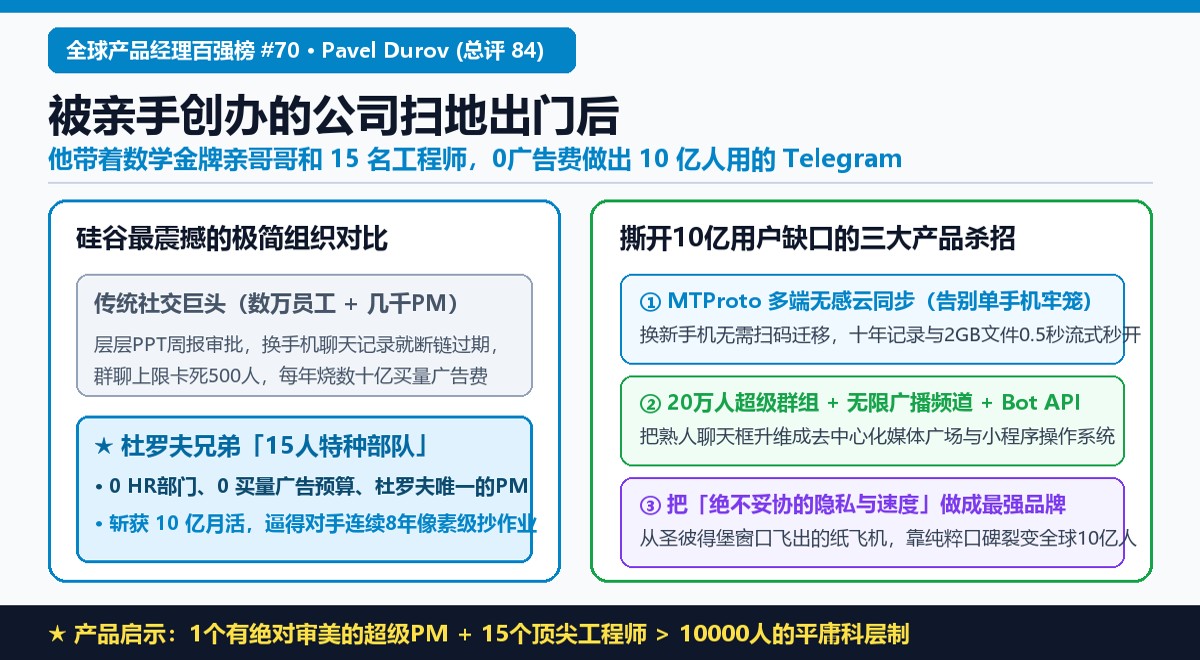
When Telegram launched in August 2013, critics dismissed it: WhatsApp, WeChat, and Messenger already owned mobile messaging. Yet Durov carved out 1 billion monthly active users through three architectural breakthroughs:
- Instant Multi-Device Cloud Sync (MTProto) vs. Single-Phone Silos: While WhatsApp trapped chat histories on a single phone and forced clunky QR-code backups, Nikolai Durov’s custom MTProto protocol stored encrypted messages across distributed global jurisdictions. Log into Telegram on any laptop, tablet, or new phone and 10 years of chats and 2GB files stream instantaneously with almost zero local disk bloat.
- Turning Messaging into an Operating System (200K Supergroups, Channels & Bots): While competitors capped group chats at 256 or 500 people, Telegram introduced 200,000-member Supergroups, unlimited broadcast Channels, and an open Bot & Mini-App API as early as 2015.
- The 15-Engineer Special Forces Org Chart: While Meta employed tens of thousands of staff to run its messaging apps, Telegram scaled past 900M–1B users with fewer than 30 core engineers, zero HR department, and $0 in paid marketing. Every engineer was recruited directly through algorithmic coding contests, and Pavel Durov served as the sole product manager reviewing every pixel and animation curve himself.
Discussion