Mocked on Launch Day as a 'Giant iPhone': How Steve Jobs's Final Category-Defining Bet Killed the Keyboard and Sold 600 Million iPads
On January 27, 2010, at the Yerba Buena Center for the Arts in San Francisco, a visibly thin Steve Jobs—recovering from a liver transplant just months earlier—walked onto a stage furnished with a leather armchair and a small coffee table.
On the big screen, Jobs placed an iPhone on the left, a MacBook on the right, and a big question mark in the middle:
“The question has arisen lately: Is there room for a third category of device in the middle, something that’s between a laptop and a smartphone? And the bar is pretty high: in order to really create a new category of devices, those devices are going to have to be far better at doing some key tasks than a laptop or a smartphone. Otherwise, it has no reason for being.”
Then Jobs sat back in the leather armchair, picked up a 9.7-inch sheet of multi-touch glass, and showed the world the iPad.
Within 48 hours, the Silicon Valley tech press and internet forums erupted in near-unanimous mockery:
- Hardcore tech blogs lamented: “No USB ports? No physical keyboard? No Flash? No file manager or windowed multitasking? It’s literally just an oversized iPod Touch!”
- Bill Gates shrugged in an interview: “It’s a nice reader, status quo, but there’s nothing on the iPad I look at and say, ‘Oh, I wish Microsoft had done it.’ People want a stylus and a real keyboard.”
#iTampontrended globally on Twitter as late-night hosts joked about the nameiPad.
Then real consumers voted with their wallets: Apple sold 1 million iPads in just 28 days—more than twice as fast as the original iPhone—and shipped 15 million units in its first nine months, making it the fastest-adopted consumer electronics category in human history. Over the next fifteen years, Apple shipped more than 650 million iPads, turning every rival tablet effort into a footnote.
On our 100 Products That Changed the World leaderboard, the iPad ranks #52 globally with an OVR of 85 (Originality 85 / Scale 84 / Impact 85 / Experience 86 / Business 86 / Durability 86). Here is why the geeks got the iPad completely wrong—and why Steve Jobs actually invented the iPad before the iPhone.

1. The Inverted History: How a Dinner Party With a Bragging Microsoft Exec Sparked the iPad in 2003 (Which Then Gave Birth to the iPhone)
Most people assume Apple invented the iPhone in 2007 and then stretched its screen to create the iPad in 2010. In reality, the exact opposite happened.
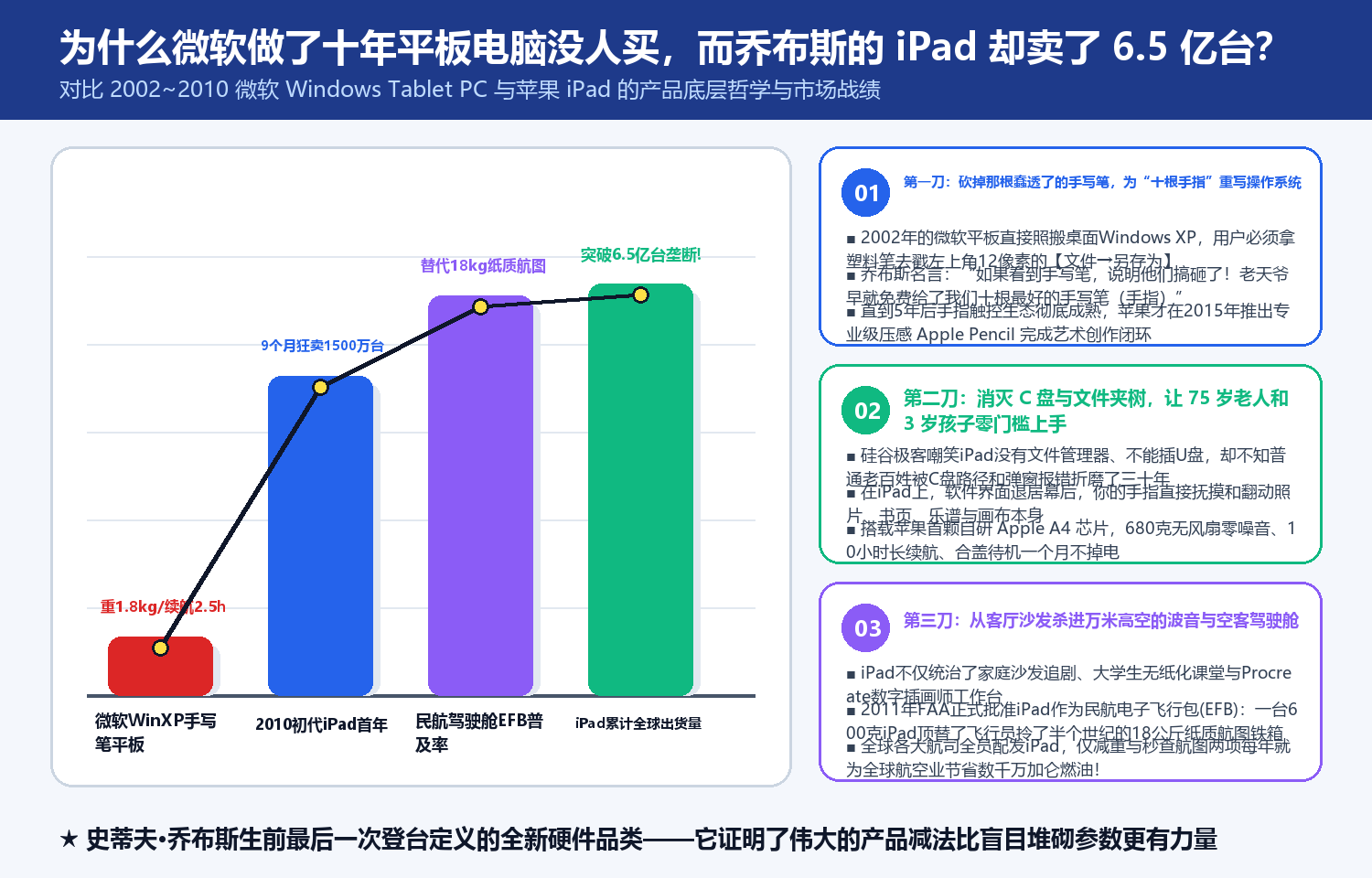
As Walter Isaacson documented in Steve Jobs, the iPad began in 2002 out of pure spite. At the time, Microsoft was aggressively promoting its Windows XP Tablet PC—a chunky, 4-pound laptop with a loud cooling fan and a cramped desktop OS that required users to poke tiny 12-pixel close buttons with a plastic stylus. A senior Microsoft executive running the Tablet PC division (who happened to be in Jobs’s social circle) invited Jobs to his 50th birthday dinner and spent the entire evening bragging about how Microsoft’s stylus tablets were going to destroy Apple’s notebooks.
Furious, Jobs marched into Apple’s design studio the next Monday morning and told Jony Ive and the hardware team:
“I want to show him what a tablet can really be! Get rid of the stylus—God gave us ten styluses, let’s not invent another! And get rid of the keyboard and the desktop OS!”
Apple launched the secret K48 tablet prototype project in 2003.
When Apple’s multi-touch engineers finally showed Jobs a 10-inch glass tablet prototype with inertial rubber-band scrolling and pinch-to-zoom in 2005, Jobs stared at the glass and realized:
“My God, we can build a phone out of this! Put the tablet on the shelf—let’s ship the phone first because everyone already carries a phone in their pocket!”
The iPhone was literally a shrunk-down spinoff of the iPad prototype. Only after the iPhone conquered the smartphone world did Jobs open the vault to finish his original 2003 vision.
2. Why Microsoft’s Decade of Tablets Failed While the iPad Conquered Three Worlds
Why did Microsoft’s Tablet PCs flop for ten straight years while the iPad sold 15 million units in year one?
1. Radical Subtraction vs. Cramming a Desktop Onto Glass
Microsoft treated a tablet as a crippled PC: they took desktop Windows—with its C:\ drives, tiny dropdown menus, right-click context trees, and hot x86 processors—and slapped a resistive touchscreen on top.
Jobs treated the iPad as direct manipulation of content:
- Zero File System Burden: No
C:\Program Files, no window management, no background task anxiety. You did not use a pointer to manipulate an interface; your fingers touched the book, the photo, or the piano keys directly. - Apple A4 Custom Silicon & 10-Hour Instant-On Battery: Powered by Apple’s first in-house custom system-on-a-chip (Apple A4), the iPad weighed just 1.5 pounds, had zero fan noise, ran for 10 hours straight, and woke up the millisecond you lifted the cover.
2. The Computer for Grandparents, Toddlers, and 800,000 Airline Pilots
The tech bloggers who mocked the iPad on launch day suffered from programmer myopia: they judged every computer by whether it could compile code in a terminal. They completely missed the three massive populations who hated traditional laptops:
- Grandparents and Non-Tech Seniors: Millions of older adults who were terrified of double-clicking a mouse or breaking Windows folders picked up an iPad and within 3 minutes were pinching to zoom in on family photos and FaceTiming their grandchildren.
- Young Children and Classrooms: Toddlers who could not yet read or use a mouse intuitively swiped, drew, and learned on the iPad glass.
- Every Commercial Airline Cockpit on Earth: Before 2011, every commercial airline pilot had to haul a 38-pound (18 kg) flight bag stuffed with 12,000 pages of paper navigation charts into the cockpit. Within two years of the iPad’s launch, the FAA approved the iPad as an Electronic Flight Bag (EFB)—replacing 38 pounds of paper with a 1.5-pound tablet in virtually every Boeing and Airbus cockpit worldwide and saving airlines tens of millions of gallons of jet fuel annually!
3. Jobs’s “Trucks vs. Cars” Prophecy
At the D8 conference in June 2010—one of his final public interviews—Steve Jobs delivered his famous Trucks vs. Cars analogy:
“When we were an agrarian nation, all cars were trucks, because that’s what you needed on the farm. But as vehicles started to be used in the urban centers, cars got more popular. PCs are going to be like trucks: they’re still going to be around, they’re still going to have a lot of value, Conditionally—1 in X people will need them. Rate of growth is going to be in cars.”
And once developers had spent five years perfecting finger-first touch interfaces, Apple gracefully closed the loop in 2015 with iPad Pro and Apple Pencil—turning the glass slate that geeks once dismissed as a “couch toy” into the world’s most beloved digital sketchbook, notebook, and portable cinema.
Discussion