Arriving 13 Years After Internet Explorer: How Google Chrome Won 65% of the World on Just Two Things—Speed, and One Tab Crashing Without Killing the Rest
In tech strategy, there is an unwritten rule: never pick a head-on fight against an incumbent that owns 100% OS pre-installation distribution and has a 13-year head start.
In 2006, Microsoft’s Internet Explorer (IE) owned over 85% of the global browser market. After crushing Netscape in the first browser war, Microsoft became so complacent that it largely disbanded the IE feature team—leaving IE6 stagnant without a major update for five straight years (2001–2006).
Anyone who used the web in 2006 remembers the daily torture:
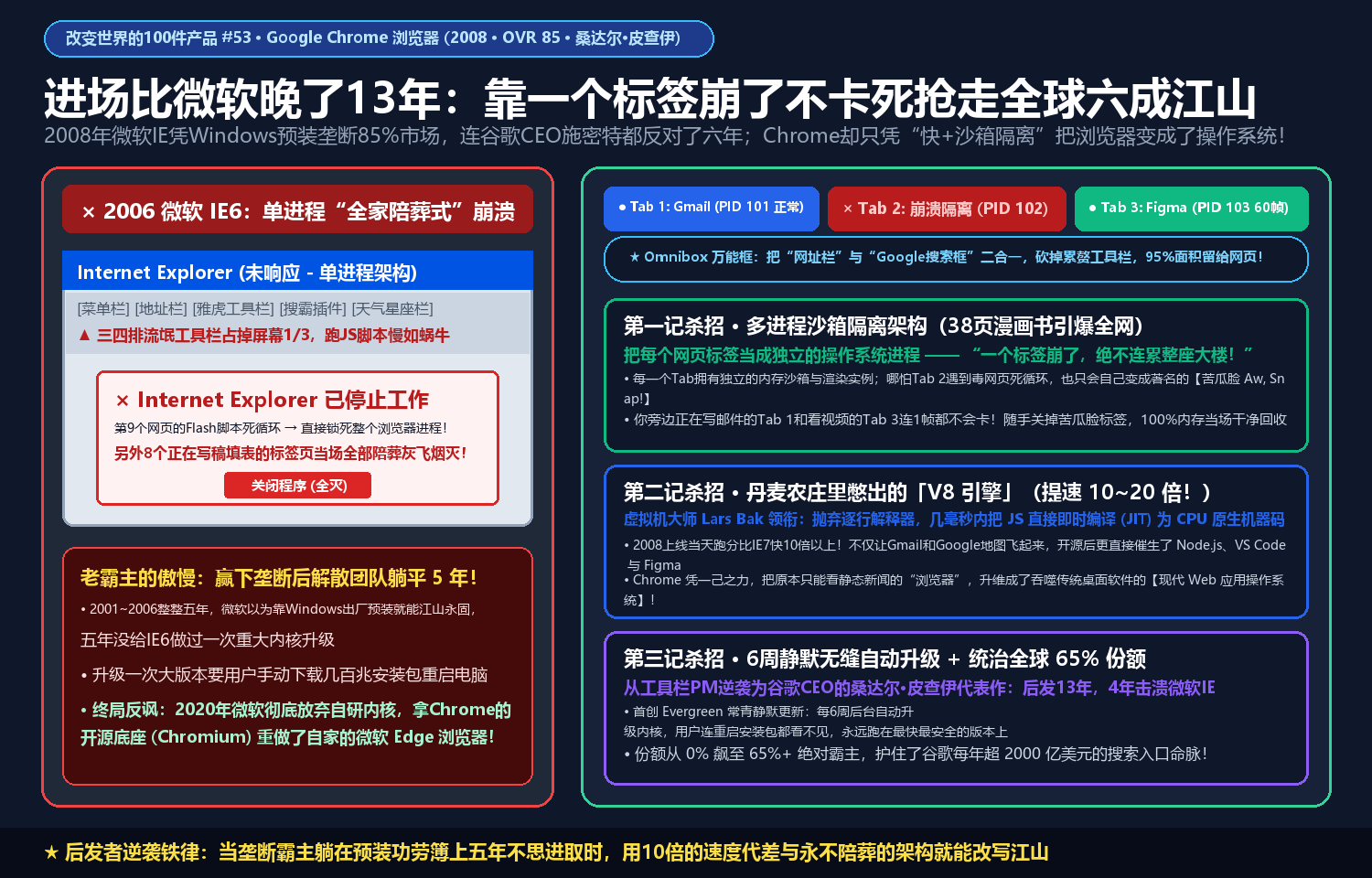
- Single-Process Russian Roulette: You had 8 tabs open—including an email or tax form you had been filling out for thirty minutes. You clicked a 9th tab containing a buggy script or Flash ad, and boom—the entire browser froze gray with
"Internet Explorer has encountered a problem and needs to close."One bad tab murdered every other open tab instantly. - Toolbar Bloat and Glacial JavaScript: The top third of the screen was choked with four rows of third-party toolbars, while modern web apps like Gmail and Google Maps crawled at a snail’s pace.
When a young Google product manager running the Google Toolbar team—Sundar Pichai (now CEO of Alphabet)—proposed building Google’s own browser, Google CEO Eric Schmidt said no for six years: “The browser war is over, and Microsoft won. Fighting them will bleed us dry.”
Undeterred, Pichai, Larry Page, and Sergey Brin quietly hired away veteran Firefox engineers and built a secret prototype. Five minutes after testing it on his own machine, Schmidt admitted: “I was wrong. Ship it.”
Launched on September 2, 2008—accompanied by a brilliant 38-page comic book drawn by Scott McCloud—Google Chrome overtook IE within four years, captured 65%+ of global browser share, and eventually forced Microsoft to abandon its own engine and rebuild Microsoft Edge on top of Chrome’s open-source Chromium core.
On our 100 Products That Changed the World leaderboard, Google Chrome ranks #53 globally with an OVR of 85 (Originality 75 / Scale 91 / Impact 92 / Experience 86 / Business 79 / Durability 89). Here are the three product decisions that turned a 13-year latecomer into the operating system of the modern web.
1. Treating Tabs Like OS Processes: “One Tab Crashes, the Rest Keep Running”
Every browser before 2008 was built on a 1995 assumption: a web page is just a static document, so the entire browser should run inside a single operating system process. By 2008, web pages were complex software applications. In a single-process browser, a memory leak or infinite loop in Tab #7 corrupted the shared thread and crashed Tabs #1 through #6.
Chrome threw out the 1995 architecture and treated the browser like a modern multi-process operating system:
- Strict Process Isolation & Sandboxing: Every tab ran in its own isolated OS process with its own dedicated memory space and rendering engine instance.
- If a rogue web page crashed, only that single tab showed the iconic “Aw, Snap!” sad-tab icon, while your Gmail draft and video stream in adjacent tabs kept running without dropping a single frame. Close the tab, and 100% of its memory was reclaimed cleanly by the OS.
2. The Danish Farmhouse & the V8 Engine: A 10× Speed Leap That Gave Birth to the Modern Web App
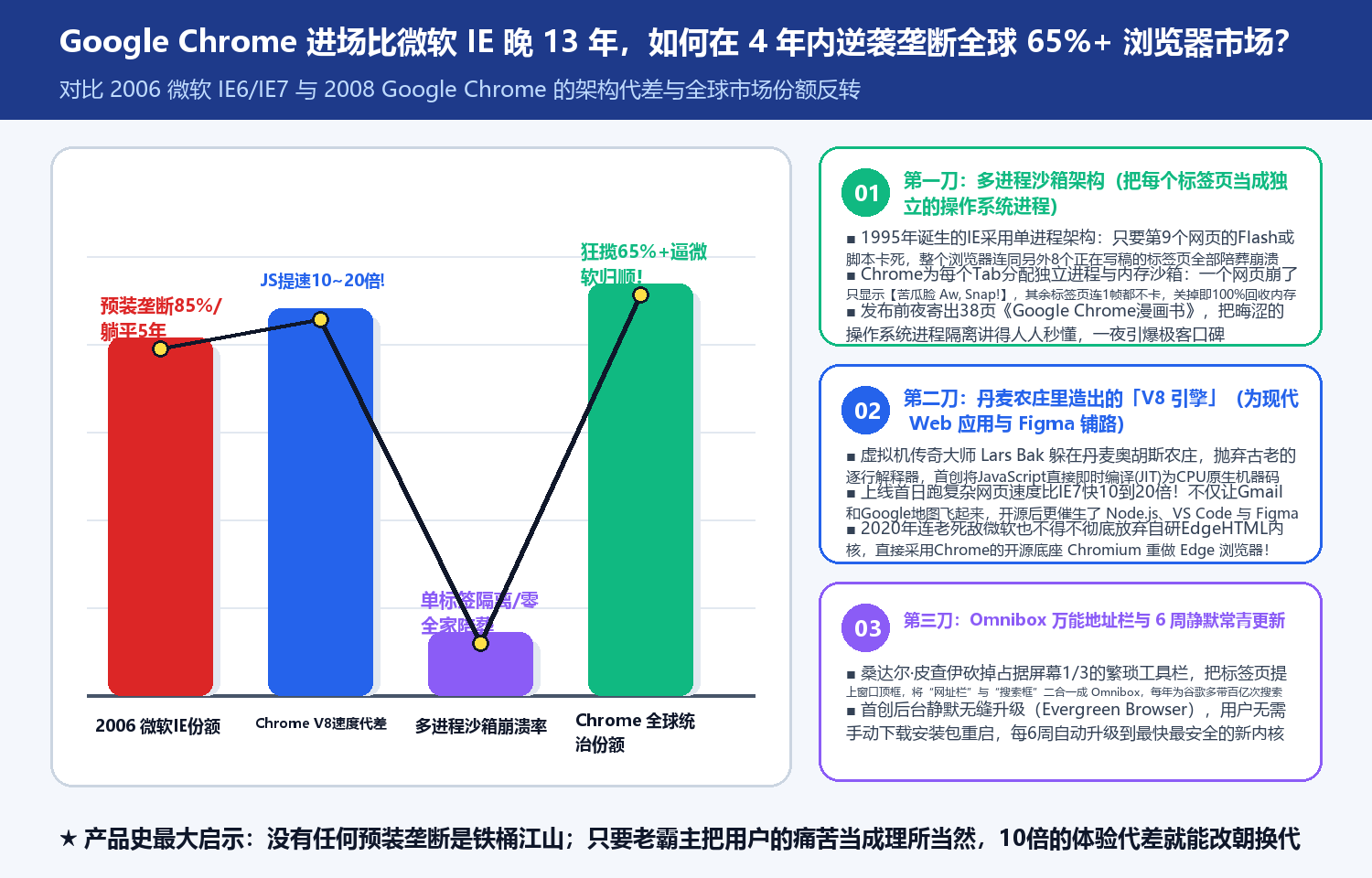
To make web applications feel as snappy as native desktop software, Google recruited legendary Danish virtual-machine architect Lars Bak. Working out of a quiet farmhouse near Aarhus, Denmark, Bak and his team built the V8 JavaScript Engine:
- Instead of interpreting JavaScript line by line at a crawl, V8 compiled JavaScript directly into native CPU machine code on the fly (JIT compilation) with hidden classes and generational garbage collection.
- On launch day, Chrome ran complex JavaScript 10× to 20× faster than Internet Explorer 7.
- By open-sourcing V8 and Chromium, Chrome didn’t just win the browser market—it laid the foundation for Node.js, Electron (VS Code, Slack), Notion, and Figma, transforming the web browser from a document viewer into the universal runtime of the 21st century.
3. The Omnibox & Evergreen Silent Updates
Finally, Sundar Pichai stripped away every ounce of visual clutter:
- The Omnibox: Instead of separating the URL address bar from a tiny search box on the right, Chrome merged both into a single unified input bar—driving tens of billions of incremental Google searches while reclaiming screen real estate.
- Silent 6-Week Evergreen Updates: Users never had to download an installer to upgrade from “Chrome 1 to Chrome 2.” Chrome updated silently in the background every six weeks, ensuring the entire planet ran on the fastest, most secure web platform automatically.
Discussion