From Selling Cereal Boxes to Convincing the World to Sleep in Strangers' Homes: How Airbnb Engineered Trust
Imagine it is 2008. Two broke industrial designers with maxed-out credit cards ask you to invest $150,000 for 10% of their startup. Their pitch:
“We built a website where travelers pay to sleep on air mattresses on the living-room floors of complete strangers.”
Seven top Silicon Valley angel investors heard that exact pitch in 2008. Five said no immediately; two didn’t even bother replying. (Had any of them wired that $150,000, their stake would be worth over $8 billion today.)
On the doaipm.com Top 100 Products leaderboard, Airbnb ranks #62 (Overall 84, Originality org: 92, Impact imp: 90): “Convincing the world to sleep in a stranger’s home took no deep-tech miracle—it took double-blind reviews, a million-dollar guarantee, and founders who went door to door taking the photos themselves.”
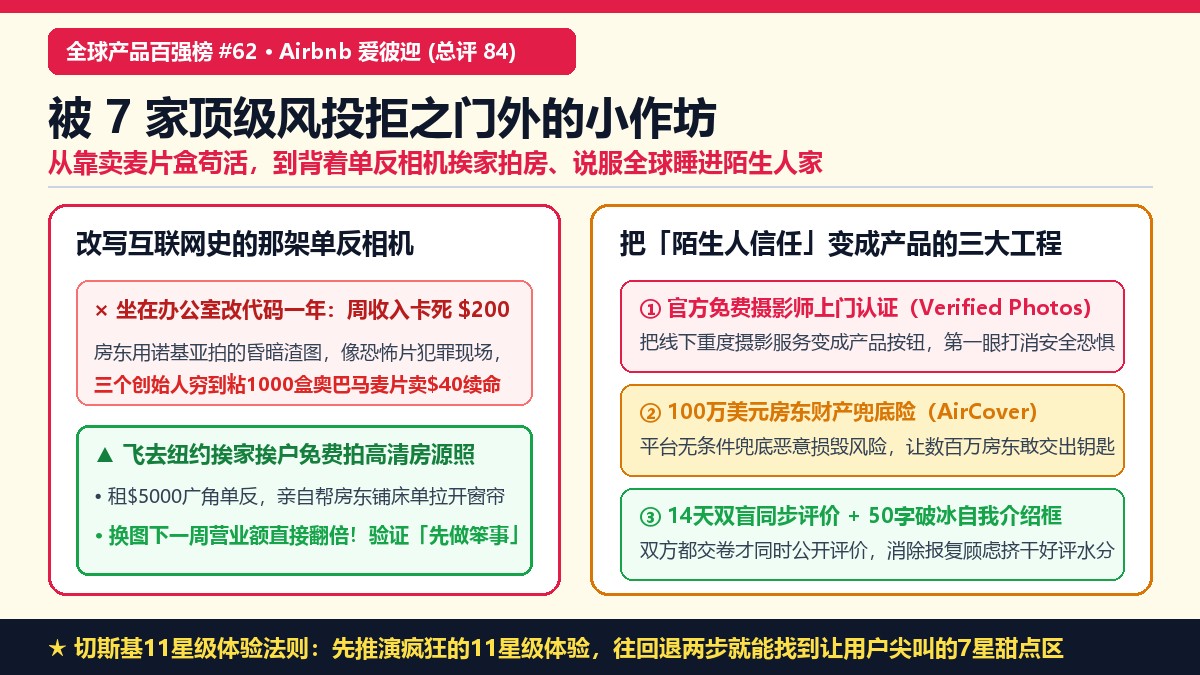
1. Three Airbeds, $200 a Week, and 1,000 Boxes of Obama O’s
In October 2007, RISD graduates Brian Chesky and Joe Gebbia couldn’t make the $1,150 rent on their San Francisco apartment. With all hotel rooms sold out for a local design conference, they inflated three airbeds, teamed up with engineer Nathan Blecharczyk, and launched AirBedAndBreakfast.com at $80 a night.
Yet for an entire year afterward, weekly revenue flatlined at $200 a week. Desperate to stay alive during the 2008 U.S. presidential election, the founders hand-folded and hot-glued 1,000 limited-edition cereal boxes (Obama O’s and Cap’n McCain’s) and sold them at $40 a box, netting $30,000 to pay off debt. That cockroach survival grit convinced Y Combinator’s Paul Graham to fund them.
2. The DSLR Camera That Doubled Revenue Overnight
Even inside YC, growth remained flat—until Paul Graham told them to stop staring at analytics dashboards in California and fly to New York to meet their hosts.
Looking at the New York listings together with hosts, Chesky saw the bottleneck immediately: the photos were awful—blurry, dark camera-phone shots that made apartments look like crime scenes.
Instead of writing code, Chesky rented a $5,000 Canon DSLR lens and knocked on dozens of New York hosts’ doors himself, fluffing pillows, opening curtains, and shooting bright, wide-angle architectural photos. One week after replacing the photos, Airbnb’s New York revenue doubled—birthing Silicon Valley’s most famous maxim: “Do things that don’t scale.”
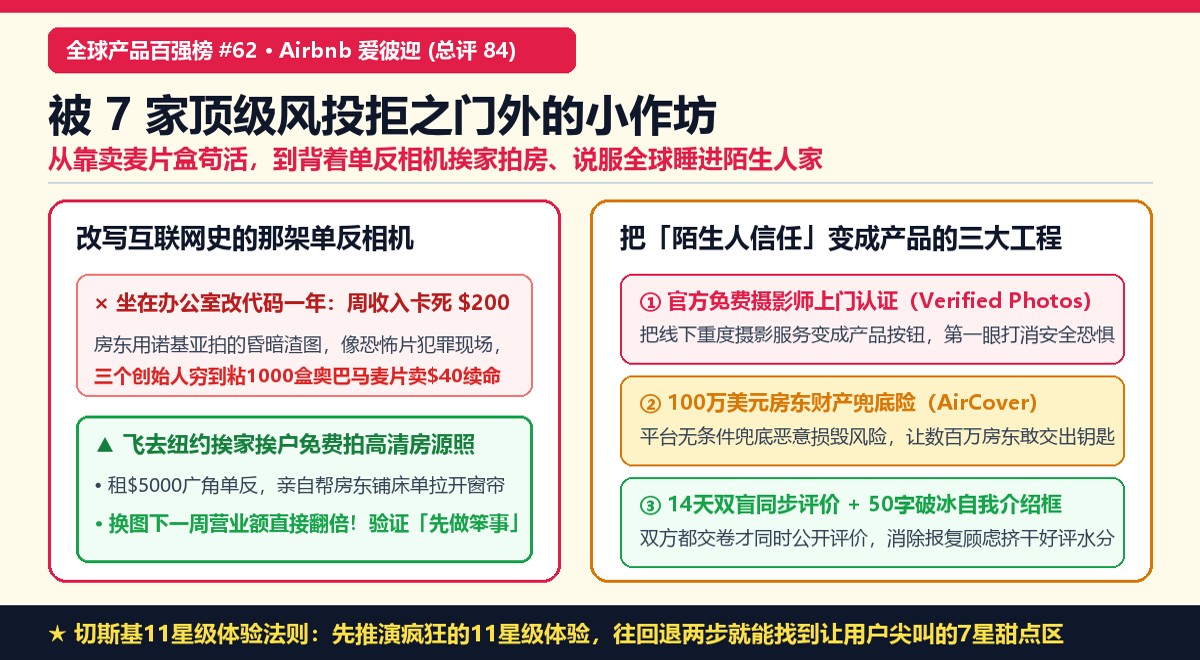
3. Engineering Trust at Global Scale
To turn hospitality between strangers into a repeatable system, Airbnb built three product pillars:
- The $1,000,000 Host Guarantee (now AirCover): Turned catastrophic tail risk from an individual nightmare into a platform-backed insurance moat.
- 14-Day Double-Blind Reviews: Neither host nor guest can see the other’s review until both have submitted theirs—eliminating retaliation fear and surfacing honest signal.
- The 11-Star Experience Design Method: Working backwards from an absurdly magical 11-star fantasy to discover the achievable 6- and 7-star product details that turn customers into lifelong evangelists.
Discussion