'Will Free Money Turn Everyone Into Lazy Couch Potatoes?' Inside the Massive UBI Trials in Finland, Canada, and Silicon Valley That Proved the Critics Wrong
Whenever we argue that the explosion of AI and robotic productivity must be paired with Universal Basic Income (UBI) to guarantee every human being’s right to survive, one visceral objection always dominates the comment section:
“Human nature is inherently lazy! If the government deposits $1,000 a month into everyone’s bank account with no strings attached, workers will quit en masse to play video games, drink, and rot on the couch! Only the fear of hunger and eviction keeps civilization running!”
For two centuries, this “whip of scarcity” philosophy has served as the primary shield against unconditional economic security. Yet science does not care about paternalistic intuition—science cares about randomized controlled trials (RCTs).
Over the past fifty years, governments and Nobel-winning economists across Finland, Canada, the United States, and Kenya have quietly run rigorous, multi-year UBI experiments tracking more than 20,000 real human beings. Today, let us lay the hard ledger of the three greatest basic income trials in history on the table—and see what actually happens to human beings when you remove the terror of not making next month’s rent.
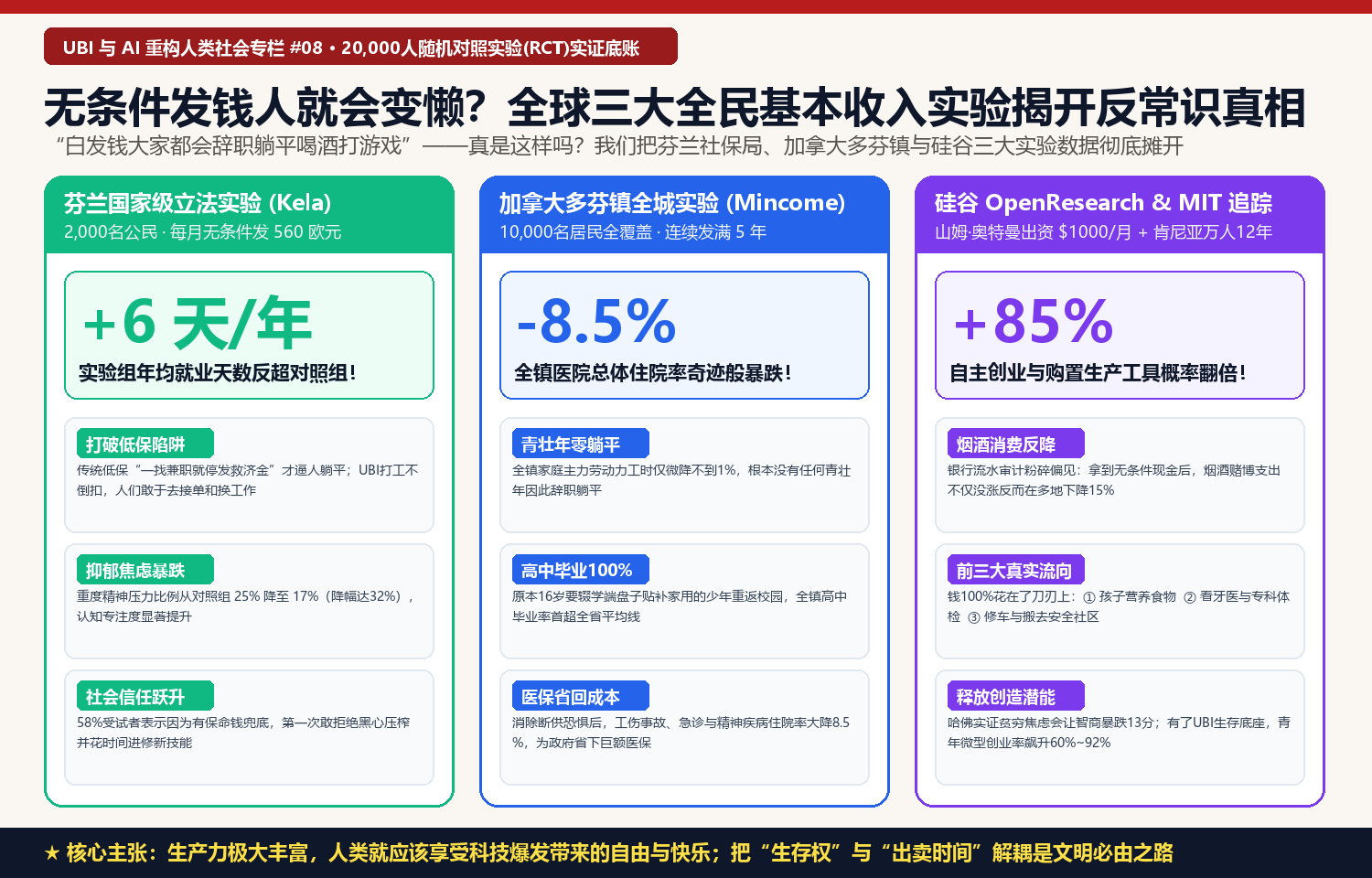
1. The Finnish National Experiment (Kela, 2,000 Citizens): Why Means-Tested Welfare Is the Real Laziness Trap
Between January 2017 and December 2018, the Social Insurance Institution of Finland (Kela) conducted the world’s first nationwide, randomized statutory basic income trial. The government randomly selected 2,000 unemployed citizens aged 25 to 58 and paid them €560 per month unconditionally, comparing them against a control group of 173,000 citizens under the traditional unemployment system.
Consider the structural difference between traditional welfare and UBI:
- Traditional Means-Tested Welfare (The Bureaucratic Trap): To keep receiving benefits, you must prove you are poor and jobless. The moment you take a part-time gig or start a small business, bureaucrats claw back 80% to 100% of your benefit—creating an effective marginal tax rate of nearly 100% that actively punishes people for working.
- Unconditional Basic Income (UBI): Whether you stay home, take a full-time job, or launch a startup, you keep 100% of your €560 floor. Work always adds to your income instead of subtracting your safety net.
When the University of Helsinki published the final audit, the results demolished every prediction of the anti-UBI camp:
- Employment Actually Increased: Recipients of unconditional cash worked 6 more days per year on average than the control group during the full evaluation period. Freed from the welfare clawback trap, people took risks on new jobs and freelance work.
- Severe Stress and Depression Dropped by a Third: Only 17% of UBI recipients reported high mental distress compared to 25% in the control group, with sharp gains in cognitive focus and trust in societal institutions.

2. Canada’s “Mincome” Saturation Site (Dauphin, Manitoba): An 8.5% Drop in Town-Wide Hospitalizations
Even more dramatic was the Mincome experiment (1974–1979) jointly funded by the Canadian federal government and Manitoba, which turned the entire town of Dauphin (population ~10,000) into a saturation site where every resident was guaranteed a basic income floor.
When economist Dr. Evelyn Forget analyzed decade-long health, tax, and school records comparing Dauphin against matched control towns, three extraordinary findings emerged:
1. Who Worked Less? New Mothers and Teenagers Finishing High School
Primary breadwinners in Dauphin reduced their working hours by less than 1%—virtually nobody quit their job to lie on the couch. Only two groups significantly reduced paid wage labor:
- New mothers, who used the basic income to stay home with their newborn infants for several additional months instead of rushing back to factory shifts;
- Teenage boys from low-income families, who previously dropped out at 16 to work minimum-wage jobs to help pay family bills. During the Mincome years, Dauphin’s high school completion rate surged past 100% (including returning dropouts), beating the provincial average for the first time in history!
2. Hospital Admissions Across the Entire Town Plunged by 8.5%
Most remarkably, hospital records showed that overall hospitalizations in Dauphin fell by 8.5% compared to control towns! Workplace accidents, emergency room visits for domestic injuries, and psychiatric admissions for anxiety and depression dropped precipitously. Simply eliminating the chronic cortisol poison of financial terror saved the public healthcare system millions of dollars.
3. OpenResearch & GiveDirectly: Vice Spending Falls While Entrepreneurship Doubles
In recent years, Sam Altman-backed OpenResearch (which gave $1,000/month unconditionally to low-income Americans for 3 years) and MIT/World Bank 12-year evaluations of GiveDirectly in Kenya tested the second favorite myth of UBI critics: “If you give poor people cash, they will blow it on alcohol, tobacco, and gambling.”
- Zero Surge in Vice Goods: Across dozens of audited trials, spending on alcohol and tobacco either remained flat or decreased (as despair-driven self-medication subsided). The top categories of spending were consistently nutritious food, preventative dental and medical care, housing stability, and children’s education.
- Entrepreneurship Surge: Recipients with an unconditional survival floor were 60% to 90% more likely to start micro-enterprises or invest in productive assets compared to control groups.
4. The Verdict: Scarcity Paralyzes Human Potential; Security Unleashes It
As Harvard behavioral economist Sendhil Mullainathan proved in Scarcity, chronic financial insecurity imposes a cognitive load equivalent to losing 13 IQ points—the same as going a full night without sleep. People do not become industrious when threatened with starvation; they become cognitively paralyzed and trapped in survival tunnel vision.
In an age where AI and robotics are driving the marginal cost of production toward zero, clinging to the 19th-century whip of survival terror is not just cruel—it is economically illiterate. Decoupling human survival from wage labor via UBI will not end human ambition; it will unleash the greatest renaissance of learning, caregiving, entrepreneurship, and creativity in human history.
Discussion