The product history of the shipping container, and why it ranks 10th
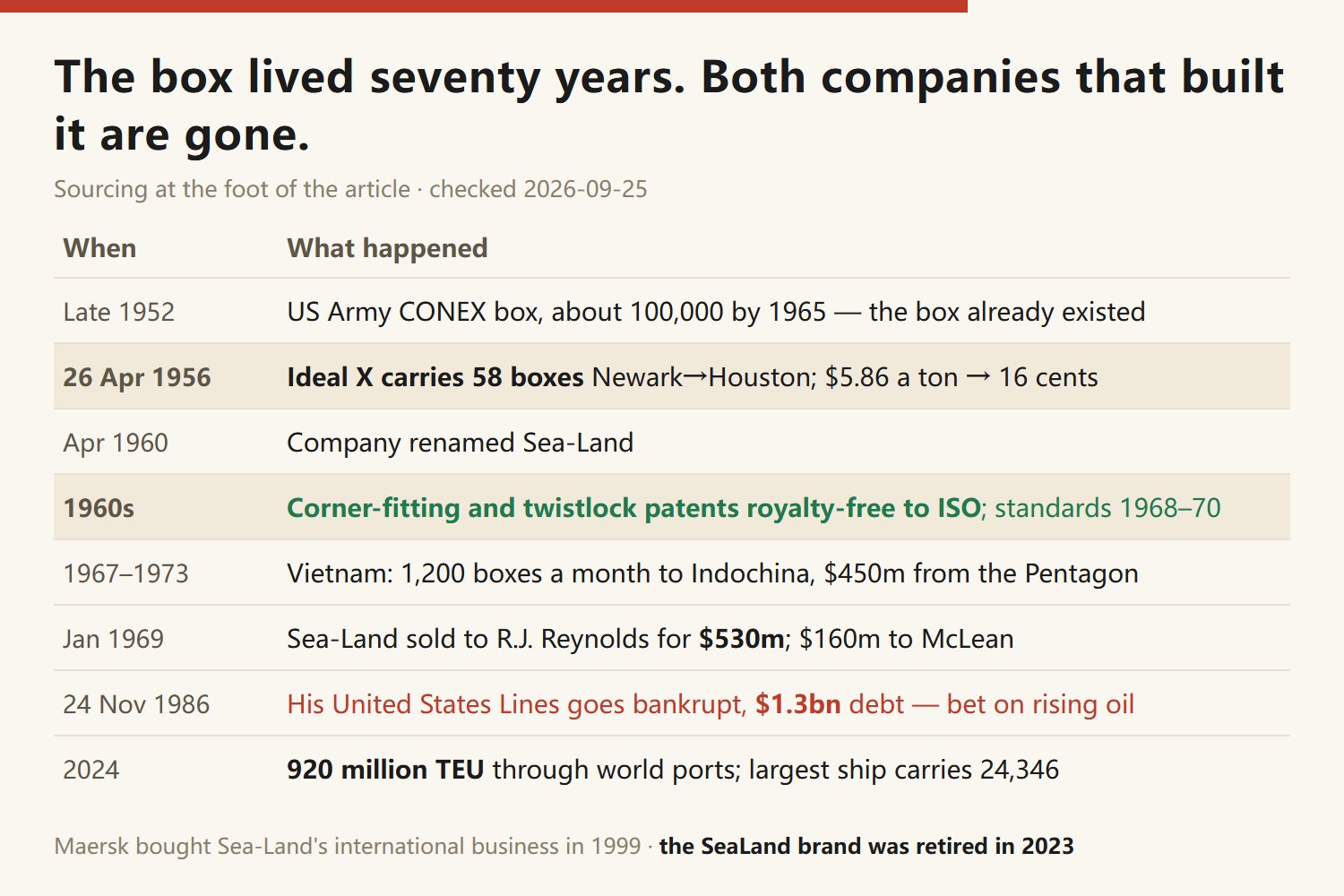
On 26 April 1956 a converted Second World War tanker called the Ideal X left Port Newark, New Jersey, for Houston, Texas. A steel rack had been fitted over her deck, and on it sat 58 aluminium boxes.
When she docked in Houston, 58 trucks were waiting. Each took one box and drove off.
At the time, loading a general cargo ship by hand cost $5.86 a ton. This voyage worked out at 16 cents a ton.
In 2024 the world’s ports handled 920 million twenty-foot equivalent units.
He did not invent the box
Start with the part that usually gets told wrong: Malcom McLean did not invent the container.
In 1766 an English canal boat was already carrying coal in ten wooden boxes. By the 1830s railways were moving containers that could be shifted onto other modes of transport. In late 1952 the US Army introduced the CONEX box, and by 1965 the military had about 100,000 of them. Even the purpose-built container ship came first elsewhere: the Clifford J. Rodgers made her debut in 1955, a year before the Ideal X.
McLean came from trucking. His problem was concrete: a truck pulls up at the pier, the cargo is unloaded piece by piece, carried into a shed, then lifted piece by piece into the hold; on the other side the whole thing runs in reverse. Every handover costs labour, time, and the risk of theft and breakage.
His idea was to stop unloading. Lift the whole trailer onto the ship. Then it turned out you did not need the wheels and chassis either. Just ship the box.
So what he built was not a box but a line: the same box lifted off one truck chassis onto a ship, and off the ship onto another chassis at the far end, with nobody touching the goods inside. The ships had to change, the cranes had to change, the terminals and the chassis had to change.
That is why originality scores 98. The box already existed. The system did not, until he ran it.
A standard only you use is not a standard
By the early 1960s the problem had changed.
McLean’s company was renamed Sea-Land in April 1960. It had more and more boxes, but other lines were building containers too, and every company used its own dimensions. Company A’s boxes would not fit Company B’s ships, or Port C’s cranes.
A box is valuable because it moves between everyone. If every company keeps its own spec, a container is just one company’s pallet.
Sea-Land’s engineer Keith Tantlinger designed two parts that made the system work: the cast-steel corner fitting on each of a box’s eight corners, and the twistlock that drops into it and turns to lock. With those, boxes could be stacked, secured on deck, and picked up by standard lifting gear.
Both were Sea-Land patents.
McLean’s choice was to make the patents available royalty-free to the International Organization for Standardization, for anyone to use. The ISO container standards were published between 1968 and 1970. Corner fittings today are governed by ISO 1161, dimensions by ISO 668.
Giving up the royalties bought something bigger: the whole world adopted his spec. His competitors’ boxes could go on his ships, and his boxes could go into any port.
A standard only you use is not a standard. A lot of industries have had to learn that again since.
Vietnam took it across the Pacific
From 1967 to 1973 Sea-Land delivered 1,200 containers a month to Indochina, earning $450 million from the US Department of Defense. In 1968–69 the Vietnam service produced 40% of the company’s revenue.
Beyond the war, it proved that containers could cross the Pacific, go into a port with poor infrastructure, and arrive on time.
In January 1969 McLean sold Sea-Land to R.J. Reynolds for $530 million in cash and stock. His personal share was $160 million.
The man who built it did not last
That could have been the end of the story. McLean came back once more.
In 1978 he bought United States Lines and spent over $1 billion expanding its fleet, including 12 “Jumbo Econships” of more than 57,000 gross tons each, the largest cargo ships yet built.
The design was a bet that oil prices would keep rising: big, fuel-efficient, and slow.
Just as the ships were delivered, freight rates fell and oil collapsed to near historic lows. The fuel the slow ships saved was no longer worth much, and they could not keep up with faster competitors. On 24 November 1986 United States Lines filed for bankruptcy with $1.3 billion in debt, one of the largest bankruptcies in US history at the time. It was liquidated by 1992.
Sea-Land passed through several owners, including CSX. In December 1999 Maersk bought its international business and renamed it Maersk Sealand. In 2023 Maersk retired the SeaLand brand for good.
McLean died on 25 May 2001, aged 87.
Both companies he built are gone. The standard he gave away moved 920 million TEU through the world’s ports in 2024.
Why it ranks here
| Dimension | Score | Note |
|---|---|---|
| Originality ORG | 98 | The box already existed; he was first to run the whole truck–ship–truck system without opening the box |
| Scale SCL | 95 | 920 million TEU through the world’s ports in 2024; the largest ship carries 24,346 |
| Impact IMP | 99 | Its highest dimension, and in the top band of the whole list. The logistics floor under globalisation |
| Experience EXP | 80 | Its lowest. Nobody “uses” a container, and it ended an entire trade |
| Business BIZ | 90 | A huge industry, but the company that made it did not keep the value |
| Longevity DUR | 98 | Seventy years, same spec, no replacement |
Overall 93.65, ranked 10th.
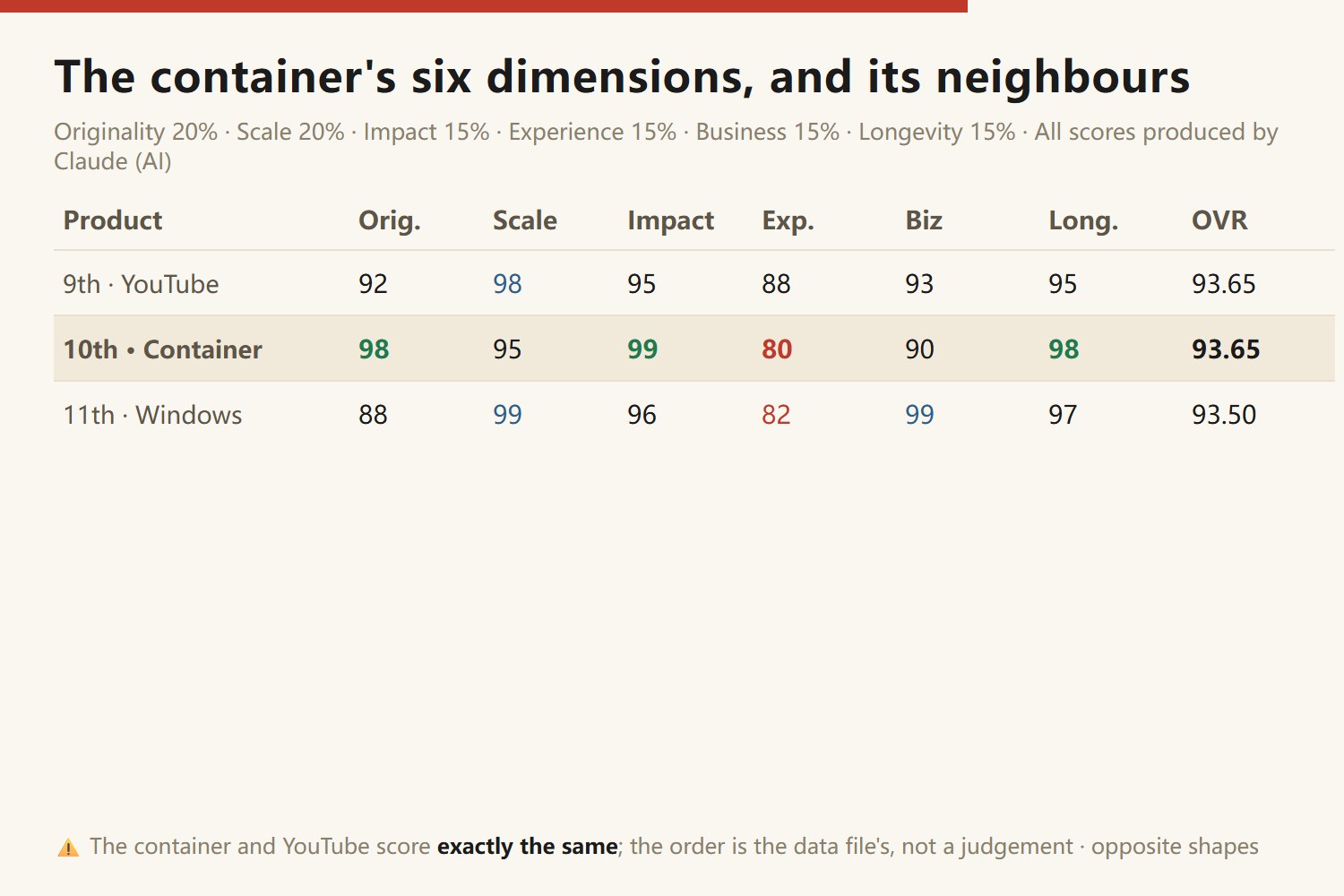
First, something to state plainly: it has exactly the same overall score as YouTube at 9th, 93.65. It sits below only because of the order the two appear in the data file. The YouTube piece noted that these two tied products have opposite shapes; this is the same comparison seen from the container’s side.
Impact 99 is the top band on this list. One economics paper tried to measure it: Bernhofen, El-Sahli and Kneller at the University of Nottingham used data from 1962 to 1990, tracking when each country built container ports and rail facilities and comparing that against trade. Their working paper concluded that between industrialised countries, the cumulative effect of containerisation over twenty years was about 700%, far larger than the effect of free trade agreements or the GATT.
Globalisation was not only negotiated at a table. A large part of it was packed into this steel box.
Longevity 98 is easy to explain. Seventy years on, the box is the same box and the corner fitting is the same fitting. Nothing has replaced it. That is exactly why this list has a longevity dimension: the iPod, the Walkman and the Model T all changed the world in their time and were then replaced. The container was not.
The deductions come in two places.
Experience 80. For the container this dimension means two things. First, nobody uses one directly: most of what you buy has spent time inside a container, and you have never seen the box. Second, and heavier: before containerisation, a ship was loaded by a gang of 20 or so longshoremen packing cargo piece by piece into the hold. Afterwards the gang was not needed. New York’s freight moved from Manhattan and Brooklyn to New Jersey, San Francisco gave way to Oakland, London and Liverpool gave way to Felixstowe and Rotterdam. A product that retires a whole trade and a set of port cities at once cannot score high on experience.
Business 90. Container shipping is an enormous industry, but this dimension asks whether the product kept its value for the people who made it. McLean’s answer is no: Sea-Land was sold, United States Lines went bankrupt, and the brand has been retired. The royalties he gave up bought the standard its victory, and meant the thing never belonged to any single company.
This is the most typical kind of product on this list: its maker handed over control, the product lived for seventy years because of it, and the company did not.
Put it next to Amazon opening its store to third-party sellers and YouTube letting rights holders choose to monetise, and it is the same move. The difference is that those two handed over a part. McLean handed over all of it.
All scores and rankings were produced by Claude (AI).
Sourcing: the Ideal X’s first voyage date, route, 58 boxes and the 58 waiting trucks come from the English Wikipedia entries for SS Ideal X and Malcom McLean; the $5.86 a ton by hand versus 16 cents by box comes from the Malcom McLean entry; the 1766 coal boat, 1830s railway containers, the CONEX box and the roughly 100,000 in service by 1965, and ISO standards published in 1968–1970 come from the Intermodal container entry; the Clifford J. Rodgers’ 1955 debut comes from the SS Ideal X entry; the April 1960 renaming, 1,200 containers a month and $450 million in Vietnam, the January 1969 sale, the December 1999 sale of the international business to Maersk and the 2023 retirement of the brand come from the Sea-Land Service entry; Vietnam’s 40% share of 1968/69 revenue, the $530 million sale price and McLean’s $160 million, the royalty-free patent release to ISO, United States Lines’ $1.3 billion debt and McLean’s date of death come from the Malcom McLean entry; Tantlinger’s design of the corner fitting and twistlock and their royalty-free release come from the Twistlock and Keith Tantlinger entries; the 12 Jumbo Econships, the 24 November 1986 filing and 1992 liquidation come from the United States Lines entry; 920 million TEU of world port throughput in 2024 comes from UNCTAD’s Review of Maritime Transport 2025; the 24,346 TEU largest ship (MSC Irina class) comes from Guinness World Records and industry reports; the trade effect comes from Bernhofen, El-Sahli and Kneller, “Estimating the effects of the container revolution on world trade” (2012 working paper, published in the Journal of International Economics in 2016). The list scores products, not people.
Discussion