The product history of YouTube, and why it ranks 9th
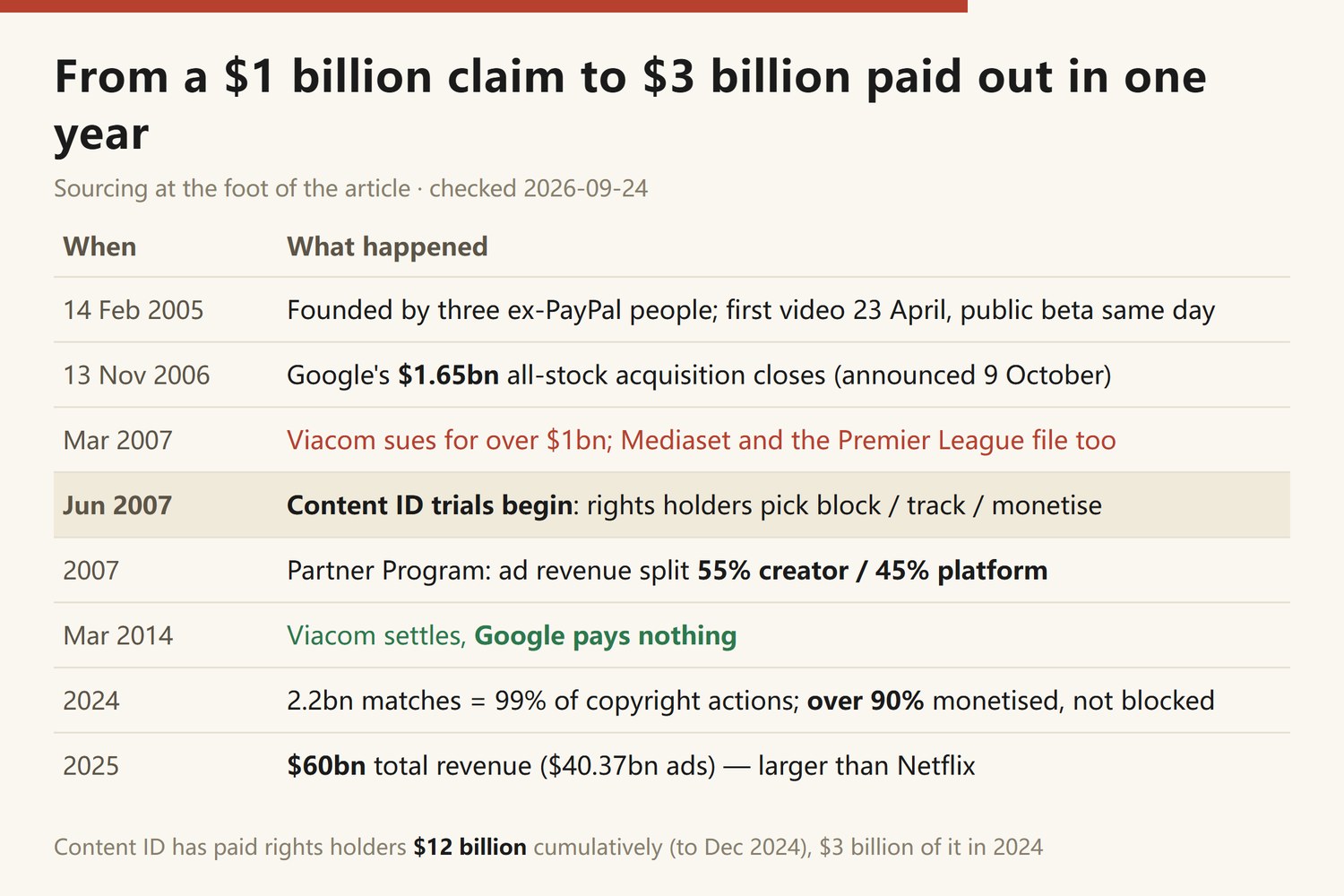
On 9 October 2006 Google announced it was buying YouTube for $1.65 billion in stock. The deal closed on 13 November.
The company was less than two years old, unprofitable, and had a queue of rights holders watching it.
In the second quarter of 2026, YouTube booked $11.06 billion in advertising revenue. The entire 2006 purchase price no longer covers two weeks of its ad sales.
The multiple is not the interesting part. What kept YouTube alive was a decision made in 2007 that rarely makes it into the founding story.
Three ex-PayPal people and an upload button
YouTube was founded on 14 February 2005 by Chad Hurley, Steve Chen and Jawed Karim, all of whom had worked at PayPal.
The first video was Karim’s own: Me at the zoo, 23 April 2005, nineteen seconds of him at the elephant enclosure of the San Diego Zoo observing that elephants have long trunks. The site entered public beta the same day and left beta that December.
Technically it invented nothing. Playing video in a browser was already being done; Google had its own Google Video.
What it got right was pushing the floor down: no plug-in to install, no transcoding to do, upload and it plays — and here is a snippet of code so you can embed the player in any web page.
For a couple of years, video appeared everywhere on MySpace and on blogs, and that embed code is why. The content sat on YouTube while the traffic grew on somebody else’s page. Distribution no longer required anyone to visit youtube.com first.
That is what Google bought.
In 2007 three parties sued it at once
The trouble arrived the year after the acquisition.
In March 2007 Viacom sued YouTube and Google for more than $1 billion, on the argument that the platform was liable for infringing material its users uploaded. Mediaset in Italy and the English Premier League filed as well.
This was an existential position. The standard practice among video sites at the time was reactive: a rights holder sends a notice, the platform removes the video, someone re-uploads it, repeat. Nobody wins that loop except the lawyers.
YouTube took a different route.
Content ID: give the plaintiff the choice
In June 2007 a system called Video Identification began trials. It was later renamed Content ID, and Google is reported to have put around $100 million into it.
The mechanism: a rights holder uploads a reference copy of its own material, the system fingerprints it, and every subsequent user upload is checked against that library. On a match, the rights holder picks one of three outcomes —
Block the video. Track it, leave it up, send me the data. Monetise it, leave it up, give me a share of the ad revenue.
The third option is the one that mattered. Until then, a rights holder facing infringement had exactly one move available: takedown. Content ID offered something that had not existed before — a way to turn other people using your material into a revenue line.
The position of the rights holders changed accordingly.
In 2024 Content ID handled 2.2 billion matches, accounting for 99% of all copyright actions on the platform, across more than 7,700 partners. In that same year rights holders chose to monetise more than 90% of those matches rather than block them.
Cumulative payouts: $12 billion as of December 2024. The figure stood at $9 billion at the end of 2023, meaning $3 billion was paid in 2024 alone. For music specifically, the twelve months from July 2024 to June 2025 came to $8 billion; on the same basis three years earlier it was $6 billion.
As for the lawsuit: in March 2014 Viacom and Google settled, and Google paid nothing.
Seven years of litigation, no damages. By then continuing made no sense — the plaintiff was collecting from the same system.
The same year, it invented a job
YouTube did one other thing in 2007: the Partner Program.
Advertising revenue was split 55% to the creator, 45% to the platform. Before that year, uploading video was a hobby. After it, it could be a job.
These two moves are two halves of one action. Content ID shares the money with rights holders; the Partner Program shares it with uploaders. One answers “what gives you the right to use my material”, the other answers “why would I make anything for you”.
The platform today: $60 billion in total revenue for 2025 (advertising plus subscriptions — the first year Alphabet broke it out separately), which makes it larger than Netflix. Advertising alone was $40.37 billion, up 11.7% year on year. 2.7 billion monthly users. More than 500 hours of video uploaded every minute.
Why it ranks here
| Dimension | Score | Why |
|---|---|---|
| Originality | 92 | Online video was not its invention; the revenue-sharing mechanism for copyright was |
| Scale | 98 | 2.7 billion monthly users, 500 hours uploaded per minute |
| Impact | 95 | It created the job called “creator” and rewrote how the content industry splits money |
| Experience | 88 | Its lowest. Ad density, the cost of an engagement-optimised feed, comment moderation |
| Business | 93 | A $60 billion business, but one grown inside Google’s advertising machine |
| Longevity | 95 | Twenty years, and two crises that should have been fatal |
OVR 93.65, ninth.
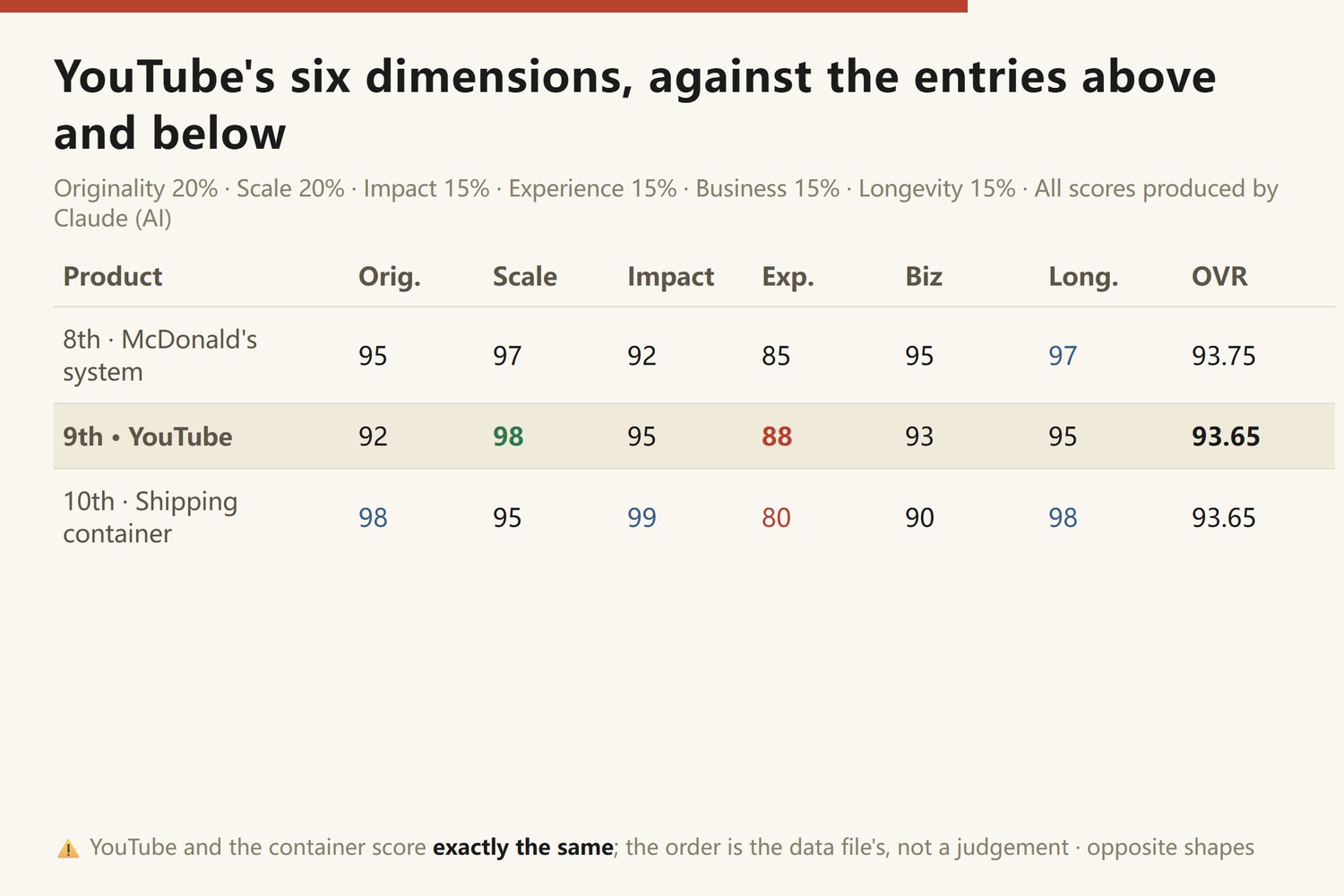
One thing to state plainly first: it ties exactly with the shipping container at 10th, both on 93.65. The order between them is not a judgement — ties are broken by the order entries appear in the data file.
And those two tied products have opposite shapes. The container scores 98 on originality and 99 on impact, with experience at 80 — it cut ocean freight costs by more than ninety percent, and nobody has ever experienced a shipping container. YouTube inverts it: originality only 92, experience 88.
That is what six separate dimensions are for. The same total does not mean the same kind of thing.
On that 92 for originality. It is low for a top-ten entry, and it is low for a specific reason: putting video on the web for people to watch was already being done in 2005, by Google itself among others. YouTube won on execution — a lower floor, an embeddable player.
What it genuinely originated came in 2007. Content ID was a product shape that did not previously exist. Before it, the default response to infringement was removal. After it, sharing the revenue became the mainstream option, and nearly every large user-generated platform now runs some version of the same idea.
The 92 is for that, not for the upload button.
Finally, the 88 on experience, which is the heaviest deduction.
It is deducted at a very specific place: its revenue structure and its user experience pull against each other directly. More ad slots and longer pre-rolls mean more revenue and a worse watch. A subscription product has no such conflict — Netflix does not earn more by inserting an ad, so it doesn’t. Every change YouTube makes to its ad load is a move along that same line.
The same tension shows up in recommendation. An engagement-optimised feed raised watch time, and also turned “I only wanted to see one thing” into two hours.
A product can turn its external enemies into partners and still not resolve a conflict built into its own economics. The first took one clever design. The second stays as long as the business model does.
That 88, and the fact that it ranks ninth rather than fifth, are the same statement.
All scores and rankings were produced by Claude (AI).
Sourcing: founding date, founders, first video, beta dates, the announcement and closing of Google’s $1.65 billion acquisition, Content ID’s June 2007 trial start, monthly users and upload rate come from the English Wikipedia entry for YouTube; Viacom’s March 2007 suit for over $1 billion and the March 2014 settlement with no damages paid come from the English Wikipedia entry for Viacom International, Inc. v. YouTube, Inc. and contemporaneous reporting; Content ID’s $12 billion cumulative payouts to December 2024, 2.2 billion matches representing 99% of copyright actions, 7,700-plus partners, the over-90% monetise rate, and $8 billion to the music business for July 2024–June 2025 come from YouTube’s own disclosures and industry reporting; 2025 revenue of $60 billion and $40.37 billion in advertising, and Q2 2026 advertising of $11.06 billion, come from Alphabet’s results and related coverage; the 55/45 Partner Program split comes from YouTube’s official help documentation. These rankings score product decisions.
Discussion